39% vs. 48%
women vs. men who have adopted generative AI, across 100+ countries
Harvard Business School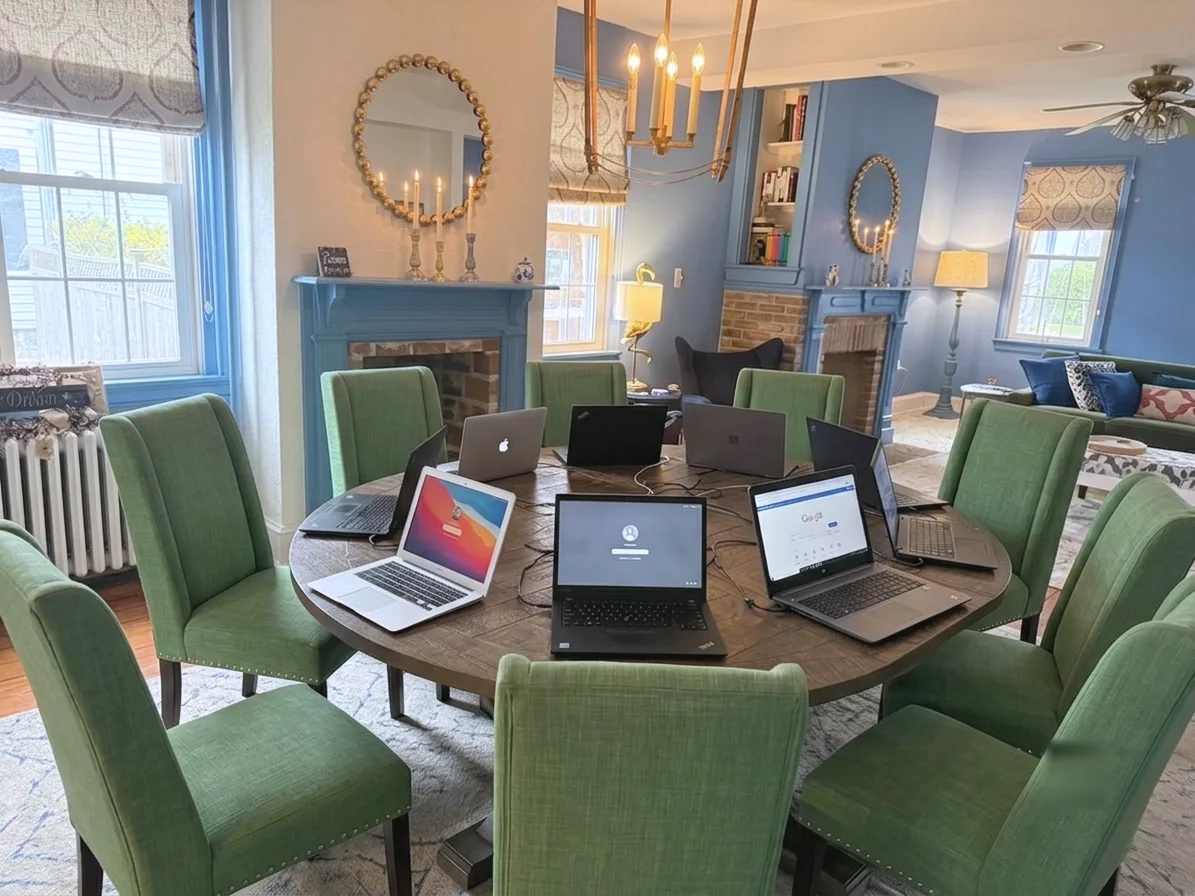
A hands-on AI workshop for women who run things.
Founding table ·
8 seats · $95 · Havre de Grace, MD
What you leave with
Bring work that has been sitting on your list for weeks. You will choose one useful outcome, finish it with guidance in the room, and leave knowing how to repeat the process.
You will not make everything below. You will pick the one thing that would make next week easier.
Turn the brief in your head into a structured, usable first draft.
Create reusable drafts that still sound like you.
Start with one conversation and shape it into a practical content plan.
Build the clear process you have never had time to write down.
Draft the job post, screening questions and interview scorecard together.
The argument
It isn’t an ability gap. It’s a support gap — and confidence is the whole of it.
You already know how to run the work. The opportunity is to stop spending your best hours on the parts a machine can shorten: the blank page, the repeated explanation, the first draft and the work of turning scattered thoughts into a usable structure.
The research explains why the room is deliberately women-only. A Harvard Business School analysis spanning more than 100 countries found that roughly 39% of women have adopted generative AI, compared with 48% of men. That does not make women less capable. It means the conditions around trying the tool have not been equal.
Men are more likely to be encouraged to experiment at work. Women are more likely to worry that using AI will be judged as cheating. Caution in that environment is not a weakness; it is an accurate reading of the room.
This table changes the conditions. No performance of technical expertise, no generic exercise and no pressure to adopt the tool for its own sake. You bring the judgment, the standards and the work that matters. AI helps with the draft.
Confidence comes from seeing the tool save time on something real. That is why this is eight women, one table and your actual to-do list—not another webinar about what AI might do someday.
You bring the judgment.
AI helps with the draft.
39% vs. 48%
women vs. men who have adopted generative AI, across 100+ countries
Harvard Business School32% more likely
to worry that using AI at work looks like “cheating”
Lean In8×
growth in the small-business gap since 2019
JPMorganChase InstituteRefreshments, introductions and the one thing you’d love off your plate.
Know what the tool can do, where it fails and what never to paste into one.
Give context, constraints and examples—the same way you would brief a smart colleague.
The heart of it. The client email, proposal, onboarding document or hiring kit. You work in pairs and leave with something you can use.
Improve the result, protect your voice and turn a good draft into a repeatable process.
Three next tasks, a take-home kit and two weeks of follow-up while you practise.
Bring a laptop. No experience needed.

Your host
Emily has spent more than 15 years making complex systems and ideas useful, from global organizations including Apple, Meta and Unilever to policy reform at the heart of UK government.
At Anthro Advisory, she helps organizations put evidence, human judgment and AI to work on real problems — not just talk about them.
She is an award-winning speaker, the bestselling author of We Need to Talk, and a firm believer that confidence comes from doing the thing in good company.
Havre de Grace · Harford County
This is intentionally not a conference room. Eight women work around a real dining table in a private home, with space to ask the questions that do not belong in a hundred-person webinar.
Drive times vary with traffic. The exact address, arrival instructions and parking details are sent after booking. Coming by rail? Email before you book so we can help you check the last leg.
Pick your date
November is the first table: eight seats at $95 while Emily refines the format with the founding group. The next date and price will be announced after it, with the interest list hearing first.
8 total seats
Live availability is shown in Luma checkout. Transfers, not refunds.
Dates to follow
If 12 November does not work, join the interest list for first access to the next date and price.
Tell me about the next tableNo. If you can send an email, you can do this. The room is deliberately mixed.
This is not a tool-specific sales pitch. The browser-based assistant for the November table will be named in your pre-session email, with simple setup instructions. You’ll work on your own laptop and leave with a method you can use again on Monday.
Then you’re exactly who this is for. We start by practising together on one shared example, so nobody is alone with a blank screen.
Bring the harder task you still have not solved. You will work on better briefing, iteration and judgment—not sit through a tour of basic features. The small group means Emily can meet you at your level.
Join the interest list and you will hear the next date and price before they are announced publicly. If you’ve already booked and something comes up, transfer your seat to the next table.
Eight seats, never more. That’s the whole point — small enough that nobody hides, and that everyone finishes something.
Two and a half hours, seven other women, and one thing finally off your plate.
See upcoming tablesGet first access to the next date and price. This does not subscribe you to marketing.
We’ll use these details to respond about A Seat at the Table. This does not subscribe you to marketing.
Thu 12 Nov · 1:00pm$95, everything included
Take your seat